World
Iran's Blockade Leaked. The US Was Waiting.
The M/T Tifani loaded roughly 2 million barrels at Iran's Kharg Island on April 5 and transited the Strait of Hormuz on April 9, four days before the US closed it to Iranian traffic. By April 21, US forces had the ship in the Bay of Bengal, 2,000 miles from where the oil was pumped. Kharg Island's tanks were already 74 percent full.
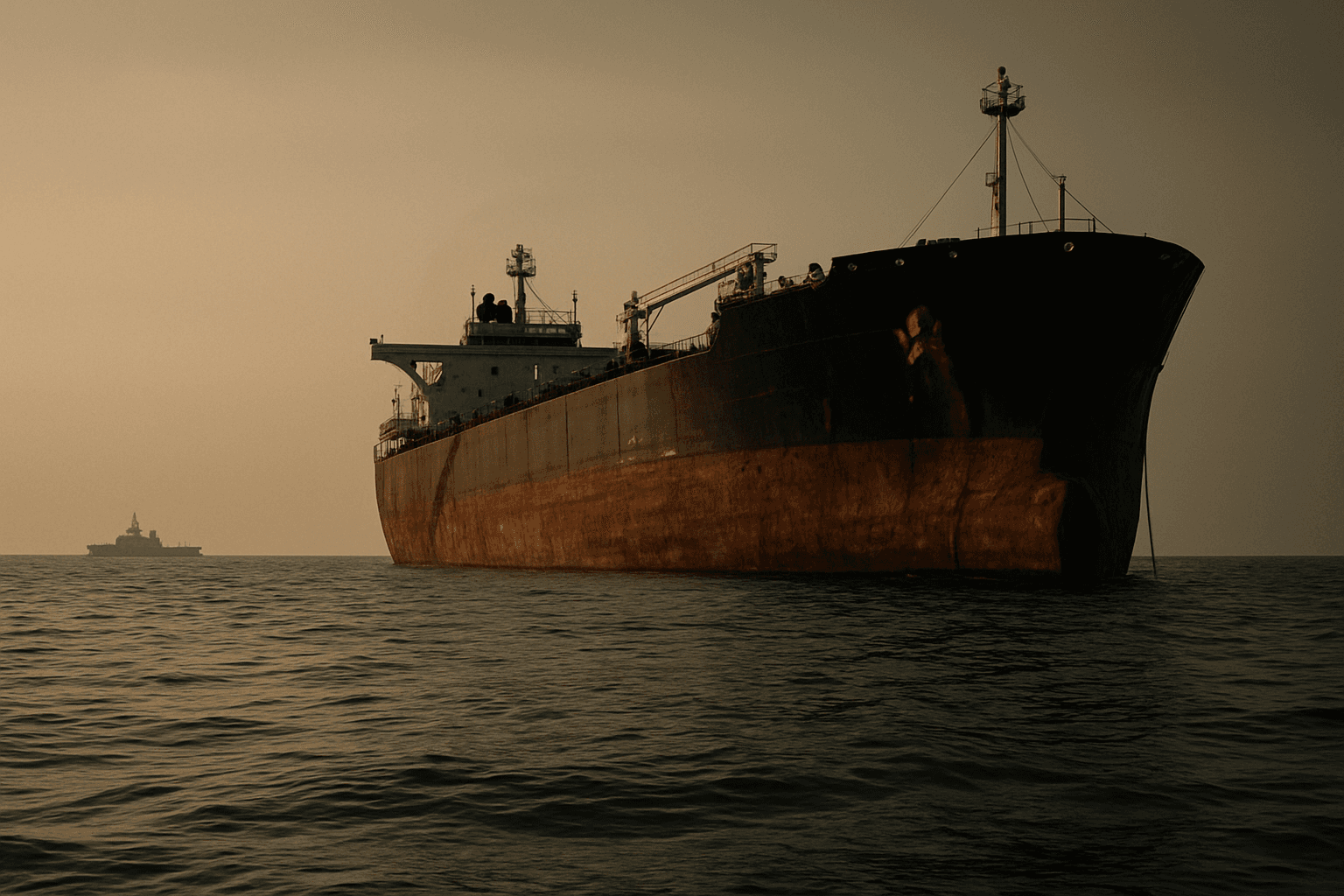
The M/T Tifani loaded roughly 1.9 million barrels of Iranian crude at Kharg Island on April 5. It transited the Strait of Hormuz on April 9, four days before US naval forces established a blockade of the strait and Iranian port approaches on April 13. It moved east through shipping lanes off Singapore and Malaysia, where on prior runs it had conducted ship-to-ship transfers that change cargo paperwork before the oil continues toward Chinese buyers. US forces intercepted the Tifani in the Bay of Bengal on April 21, more than 2,000 miles from where it loaded.
The Pentagon described the Tifani as "stateless," a designation with legal consequence. Washington is not invoking wartime maritime authority for these seizures. It is using civil forfeiture statutes targeting support for terrorism that carry, as a recent Atlantic Council analysis noted, "expansive extraterritorial application, unlike US sanctions." The theory requires the vessel to lack legitimate flag-state protection. A Botswana flag on a ship the Pentagon calls stateless is not protection. It is a target.
The same week produced a second seizure: the Majestic X, carrying approximately 1.9 million barrels of its own. Two ships, roughly 3.8 million barrels, in seven days. Treasury Secretary Scott Bessent labeled the campaign "Operation Economic Fury" and warned companies providing services to Iranian carriers that sanctions exposure applied to them too. Iran's Foreign Ministry called the actions "the outright legalization of piracy and armed robbery on the high seas."
The timing reveals a structure. Iran's blockade of the Strait of Hormuz had been in effect since February 28, reducing Western tanker transits to as few as seven per day at peak disruption. The US counter-blockade began April 13. The Tifani passed through on April 9, four days before that gate closed behind it. Iranian-affiliated vessels appear to have been using the corridor Iran nominally sealed to everyone else, moving oil eastward while inbound Western traffic sat blocked. The Tifani was not doing anything unusual. It was the one that got caught.
As of April 20, the day before the Tifani seizure, Kharg Island's onshore storage was roughly 74 percent full, with less than 3 million barrels of effective headroom against a practical ceiling of 80 percent, according to reporting by Al Jazeera. Iran has since reactivated derelict tankers as floating storage and deployed 18 vessels with Iranian oil history into the Persian Gulf and Gulf of Oman, holding roughly 35 million barrels offshore. A senior Iranian official confirmed the country had begun cutting crude output. A spokesman disputed that. Fortune reported on May 2 that Iran had a narrowing window of roughly a month before onshore capacity peaks.
The blockade Iran constructed to squeeze Western energy consumers is now applying pressure to its own production system. The seized oil stays seized. The Tifani's 1.9 million barrels never reach a buyer. What fills next is the operative question: the tanks at Kharg, or a ceasefire deal in Pakistan. The two timelines are running in parallel and neither is waiting for the other.