World
Brussels Named the Terminal. London Had Already Named the Owner.
The EU's 20th Russia sanctions package, adopted April 23, designated the Karimun Oil Terminal in Indonesia as the first port infrastructure outside Russian territory named in the EU's Russia program. The ownership chain runs through a single Dubai entity operating under two names, one of which Britain had already sanctioned four months earlier.
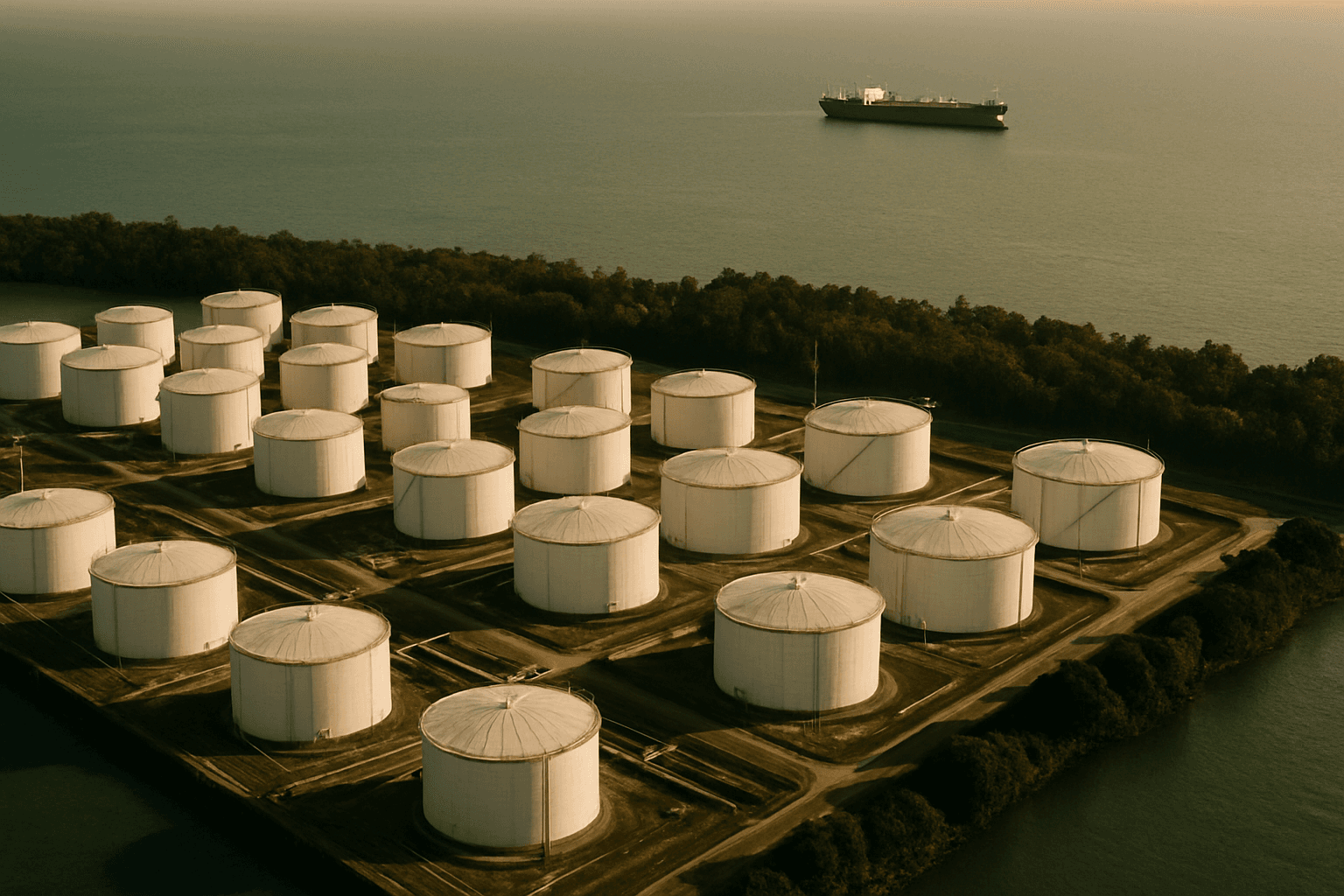
At Karimun, a free-trade zone island roughly 30 kilometers southwest of Singapore, Russian fuel oil from the Baltic terminal at Ust-Luga gets mixed with oil products from other origins and re-exported under Indonesian documentation. Western sanctions, under both EU law and UK guidance, do not apply to goods classified as Indonesian origin. The 720,000-cubic-metre storage terminal that handles this process changed hands in Q2 2024, when Germany's Oiltanking sold it to Novus Middle East DMCC, a Dubai-registered firm.
On April 23, 2026, the EU's 20th sanctions package against Russia named the Karimun Oil Terminal alongside the Russian ports of Murmansk and Tuapse, the first port infrastructure outside Russian territory to appear in the EU's Russia sanctions program. The package added 46 vessel listings to Brussels' shadow-fleet register, bringing it to 632 ships, but a terminal has no flag to change and no name to re-register.
Novus Middle East DMCC is the same legal entity as Altrum Group FZCO: both names belong to DMCC registration 116712, incorporated April 3, 2018, at Jumeirah Lakes Towers in Dubai. Britain sanctioned it in December 2025 under the Altrum name for its role in Russian energy trading. Both names trace back to 2Rivers, an Azerbaijani oil-trading group that Britain sanctioned in December 2024 and that investigative reporting from Lloyd's List and Crude Accountability has connected to Rosneft executive Igor Sechin. Brussels named the terminal 16 months after London first touched the network.
Between January and May 2025, more than 500,000 tonnes of fuel oil, roughly 3.2 million barrels, arrived at Karimun from Ust-Luga, nearly five times the comparable 2024 figure. Some 217,000 tonnes of Russian diesel arrived in the same window, against zero the prior year. By April 2025, Russian product accounted for all deliveries to the terminal, per ship-tracking data cited by Ukrainian intelligence. In March and April 2025, at least three cargoes arrived on tankers already listed by the EU or Britain; open-source shipping records do not identify those vessels by name. Tan Albayrak, an international trade lawyer at Reed Smith focusing on economic sanctions, explained the legal frame: if oil is "genuinely transformed into another oil product, then it will be considered Indonesian origin such that the Russia sanctions will no longer attach to the product." The test requires documented transformation, not mere storage and re-labeling; the compliance argument lives in the blending ratios and the processing records.
Indonesia's government has not moved to halt operations at Karimun. Hashim Djojohadikusumo, President Prabowo's Presidential Special Envoy for Energy and Environment, announced at a Jakarta briefing on April 23 that Moscow had committed to shipping 150 million barrels of crude to Indonesia, with 100 million available immediately at a special price and 50 million on standby. At Ural prices near $60 a barrel, the immediate tranche alone represents roughly $6 billion in nominally available supply, a number that helps explain why Jakarta treats the Karimun question as a procurement problem rather than a compliance one. The EU Ambassador to Jakarta clarified after April 23 that the designation targets a specific commercial facility, not state-owned Pertamina, and carries no extraterritorial reach into Indonesian law.
Whether Altrum Group FZCO winds down at Karimun or shifts the blending step to a different free-trade zone port will show up in Kpler monthly data starting in June. The EU's anti-circumvention tool, activated in the same 20th package against Kyrgyzstan-based routing of sensitive technology, treats Karimun as the same class of problem: an intermediary facility whose purpose is to change what a sanctioned cargo is before it crosses the next border.