Tech
Swift's Rescue Robot Cleared the Chamber, Not the Grab
Katalyst's LINK passed Goddard testing on May 4 and targets a June launch. The grip point is undisclosed, the arms that matter were not tested on the ground, and Swift has none of the standardized features that made satellite servicing work before.
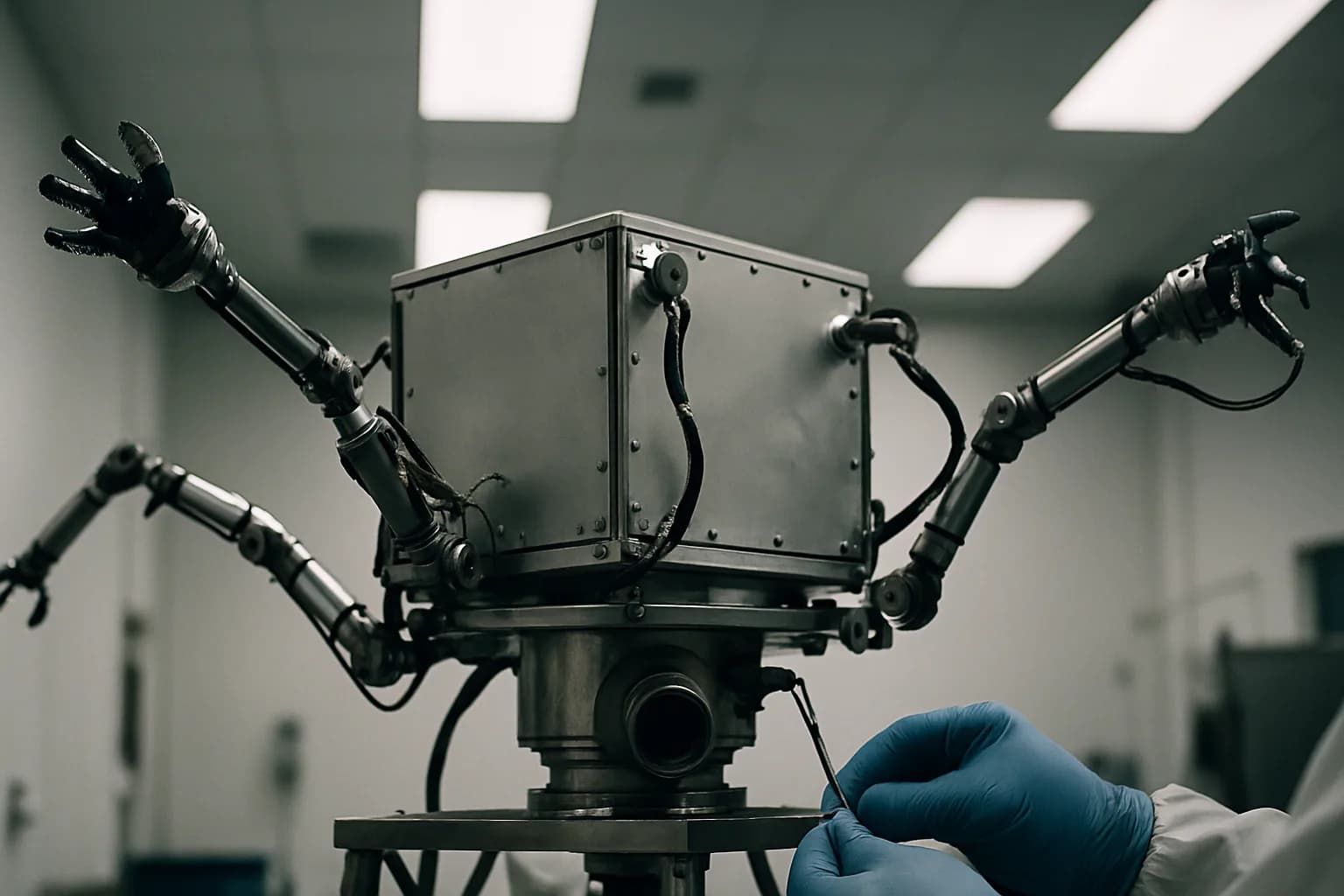
Katalyst wrapped environmental testing of its LINK spacecraft at NASA Goddard on May 4, one step short of a June launch window.
LINK's target is NASA's Neil Gehrels Swift Observatory, a gamma-ray burst telescope that flags the universe's most powerful explosions and alerts other observatories within seconds. Launched in November 2004, Swift still scans for bursts, though NASA suspended most other science operations on February 11 to reduce atmospheric drag. Solar activity has pushed its altitude from 600 to roughly 400 kilometers; without a reboost, reentry comes sometime this year.
The rescue runs on a $30 million NASA SBIR Phase 3 contract, awarded in September 2025. LINK will rendezvous with Swift, attach using three robotic arms, and fire its xenon-powered ion thrusters to push the observatory back toward its original 600-kilometer orbit. Swift has no docking ring and no designed grab points, a constraint no ground test can resolve.
Katalyst CEO Ghonhee Lee built the 770-pound LINK around Swift's unusual orbital constraints. Swift's 21-degree inclination, chosen to avoid the South Atlantic Anomaly, demands a launcher capable of matching its plane from the Pacific. Lee chose Northrop Grumman's Pegasus XL, dropped from the L-1011 Stargazer over the Marshall Islands, as the only system that fits the inclination, the schedule, and the budget.
At Goddard's Space Environment Simulator, all three ion thrusters fired and one of three robotic arms deployed, confirming propulsion and basic mechanics. The two remaining arms were not tested on the ground. They are the ones LINK needs to grip Swift.
The Open Variable
Katalyst has not publicly named which surface the arms will hold, relying instead on prelaunch photographs and consultation with NASA and Northrop Grumman engineers. Kieran Wilson, Katalyst's principal investigator, named exterior degradation as the mission's primary open variable: 21 years of micro-meteorite pitting have altered whatever Swift offers to hold. John Van Eepoel, Swift's mission director at NASA Goddard, called the effort "fast, high-risk, high-reward."
MEV-1's 2020 Intelsat capture points to what makes Swift different. Northrop's craft worked by fitting around the liquid apogee engine nozzle and launch adapter ring, a feature present on roughly 80 percent of GEO satellites. Swift is a LEO science spacecraft built without either. A successful reboost changes the calculus for the LEO science fleet, most of which was built, like Swift, with no grab interface and no equivalent opportunistic grip.
Northrop Grumman integrates LINK into the Pegasus rocket in early June at Wallops, then deploys from the Marshall Islands later that month. If the window slips and Swift's altitude drops further, LINK's propellant margin for rendezvous narrows, and the $30 million mission has no second launch opportunity.