Tech
Kroger Paid $350M to Exit a Robot Network That Needed Humans
Ocado's cube-grid sheds projected up to $100 million per module in annual revenue at Monroe's seven-module flagship. American online grocery, at roughly 10 percent of household spending, never generated the order density that math required.
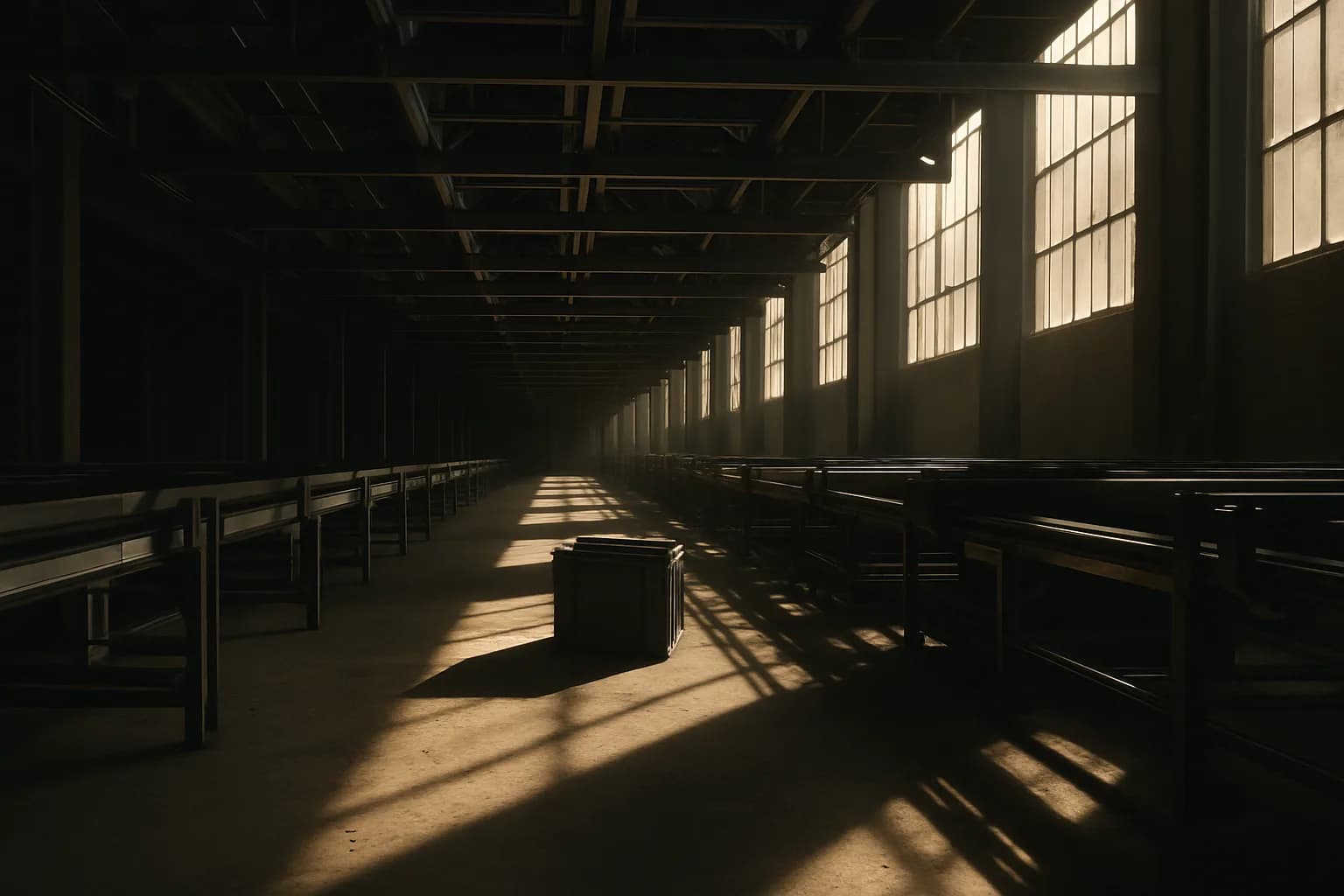
Kroger closed its Groveland, Florida fulfillment center on February 1, laying off 935 workers and handing Ocado a $350 million exit payment.
The 375,000-square-foot shed opened in June 2021 on Ocado's cube-grid automated storage platform, with bots assembling a 50-item order in five minutes. Kroger had projected 20 such centers when it announced the Ocado partnership in 2018, promising customers "anything, anytime and anywhere." Eight opened.
Three full CFCs closed in January 2026: Groveland, Pleasant Prairie, Wisconsin (211 workers), and Frederick, Maryland (83 workers, open 18 months). A Nashville spoke (132 workers) closed alongside them. Charlotte was cancelled before construction began.
Five CFCs remain in service: Monroe, Dallas, Atlanta, Denver, and Detroit.
The projection and the gap
Ocado projected $80 million to $100 million in annual revenue per module; Monroe, Ohio, Kroger's first site, has seven modules, for a full-utilization ceiling of up to $700 million. Kroger's fiscal Q3 2025 impairment across the full network reached $2.6 billion. By September 2023, CEO Rodney McMullen told investors Kroger would build no new CFCs "until we make sure that we have a clear path on the ones we have."
Ocado's cube was built in the late 1990s for British weekly-slot grocery delivery, with fixed regional order density and predictable scheduling. Bins stored deep in the 3D lattice require bots to clear every layer above them first; that reshuffle penalizes throughput under surge conditions. American online grocery stabilized at 10 to 12 percent of household spending post-pandemic, well below the density the cube architecture required.
The replacement
Kroger named Instacart its primary delivery partner in November 2025. Interim CEO Ron Sargent confirmed the direction: "in most markets it makes more sense to fulfill delivery orders from stores rather than centralized warehouses."
Orders those four facilities handled now route through Kroger's "Partner Pick" program at 2,700 stores. The program draws on Kroger store associates and external Instacart gig shoppers, a workforce with no guaranteed minimums and no Kroger benefits.
The 1,361 dedicated positions across the four closed facilities did not reappear as Kroger-employed equivalents. Store associates picking delivery orders are full-time floor workers, their delivery picking drawn from existing shifts. Gig shoppers carry no health coverage and no minimum weekly hours through Kroger's account.
Ocado's shares have shed more than 90 percent of their value since the company's September 2020 peak. The company is repositioning its U.S. pitch around a smaller in-store format, citing a $5 million annual site-revenue threshold for new partners.
The $400 million profitability improvement CFO David Kennerley tied to the CFC closures implies a specific trade. Kroger eliminated 1,361 fixed positions and absorbed their volume into store labor it already carries, plus a gig pool it does not employ or insure.
Automation's pitch to American grocery ran on labor concentration: fewer workers per order, more orders per shed, delivered from a larger radius than any single store. That arithmetic requires demand density the U.S. e-grocery market has not produced.
Watch Kroger's next earnings call for per-CFC revenue guidance on Monroe, Dallas, Atlanta, Denver, and Detroit. If Monroe is not tracking toward $700 million in annual revenue at seven modules, the demand-density gap is structural. Phoenix, still on Ocado's partner page as a 2026 opening, faces the same math.