Tech
604 Wh/kg in a Pouch. The Cycles Were Measured in a Coin.
Tsinghua's October 2025 Nature paper reached 604 Wh/kg, against 255 Wh/kg for leading commercial packs. The 500-plus cycle figure comes from coin cells; at this density tier, no group has published pouch endurance past 100 cycles.
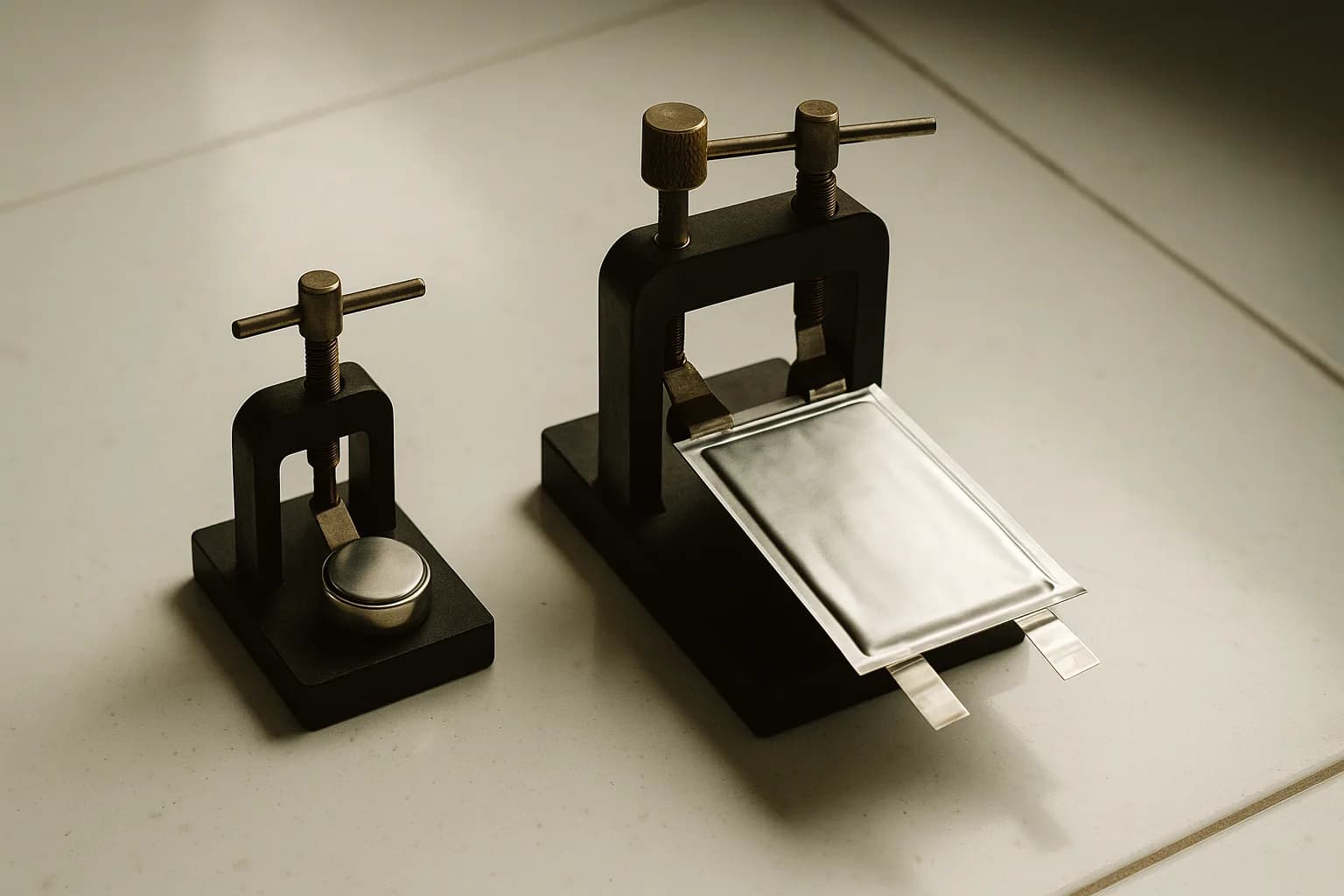
Zhang Qiang's group at Tsinghua published a 604 Wh/kg anode-free lithium metal pouch cell in Nature in October 2025, against 255 Wh/kg for leading commercial pack designs.
The electrolyte is a fluorinated polyether polymer with an anion-rich solvation structure. It suppresses oxygen release at the lithium-rich manganese oxide cathode, the failure mode that held polymer solid-state cells below 300 Wh/kg for two decades. Removing the pre-deposited lithium anode lifts volumetric density to 1,027 Wh per liter.
The paper reports two performance figures from two cell formats: 604 Wh/kg energy density from pouch cells and more than 500 cycles at 25°C from coin cells. The pouch cell's own cycle life is not separately reported. Automotive qualification requires 1,000 cycles at 80% capacity retention; QuantumScape's QSE-5 B-sample cleared that bar in October 2025 at 301 Wh/kg.
LRMO's layered crystal structure converts partially to spinel over the first hundred cycles, pulling average discharge voltage down 10 to 15 percent. The fluorinated electrolyte stabilizes the cathode-electrolyte interface; the crystal rearrangement proceeds regardless.
Adjacent Labs
No lab has published a replication of the Zhang Qiang fluorinated polyether chemistry in the seven months since the paper appeared. Xi'an Jiaotong University's fluorine chemistry lab published a 2025 RSC study using a different fluorinated cosolvent with an LRMO cathode, reaching 86.3% capacity retention after 200 cycles.
A Tianjin University team reached 604.2 Wh/kg in a 5.5-Ah Ni90 liquid-electrolyte pouch cell in Nature in August 2025 and reported 90 to 100 pouch cycles. A November 2025 Nature Communications paper hit 604.2 Wh/kg in an 11-Ah solid-state pouch and cleared 100 cycles at 92.83% retention. Three papers at the 600 Wh/kg tier in eight months; none crossed 100 pouch cycles under any chemistry.
Zhang Qiang's group has no publicly named industrial partner, which removes the nearest route from lab to production line. Chery's Solid-State Battery Research Institute, working on in-situ polymerized LRMO, plans Exeed Liefeng pilot production later in 2026 under a different electrolyte design.
First Buyers
ESOX Group's X1 interceptor drone, announced at CES 2026, integrates a 400 Wh/kg solid-state cell from Donut Lab with a production ramp targeting the second half of 2026. At 604 Wh/kg, the same airframe carries 51% more mission energy for equivalent cell mass.
The cycle-life figure missing from the Tsinghua paper forces every potential buyer to treat 604 Wh/kg as a hypothesis rather than a specification. The two groups that did publish pouch cycle data at this density, Tianjin University and a November Nature Communications team, both stopped below 110 cycles.
A senior Chinese battery industry academician, cited by Car News China in March 2026, estimated five to ten years to 1% solid-state share in passenger vehicles. Chery's Exeed Liefeng, on in-situ polymerized LRMO, starts production in late 2026; its cycle data, due early 2027, is the first public durability test the LRMO cathode class will have.