Tech
The Majorana Chip That Shipped Before the Physics Was Established
Microsoft's February 2025 Majorana 1 chip sits outside its own Nature paper's verified claims and outside Azure Quantum's provider list. The physicist who forced Microsoft's 2018 Majorana retraction calls the new work essentially fraudulent.
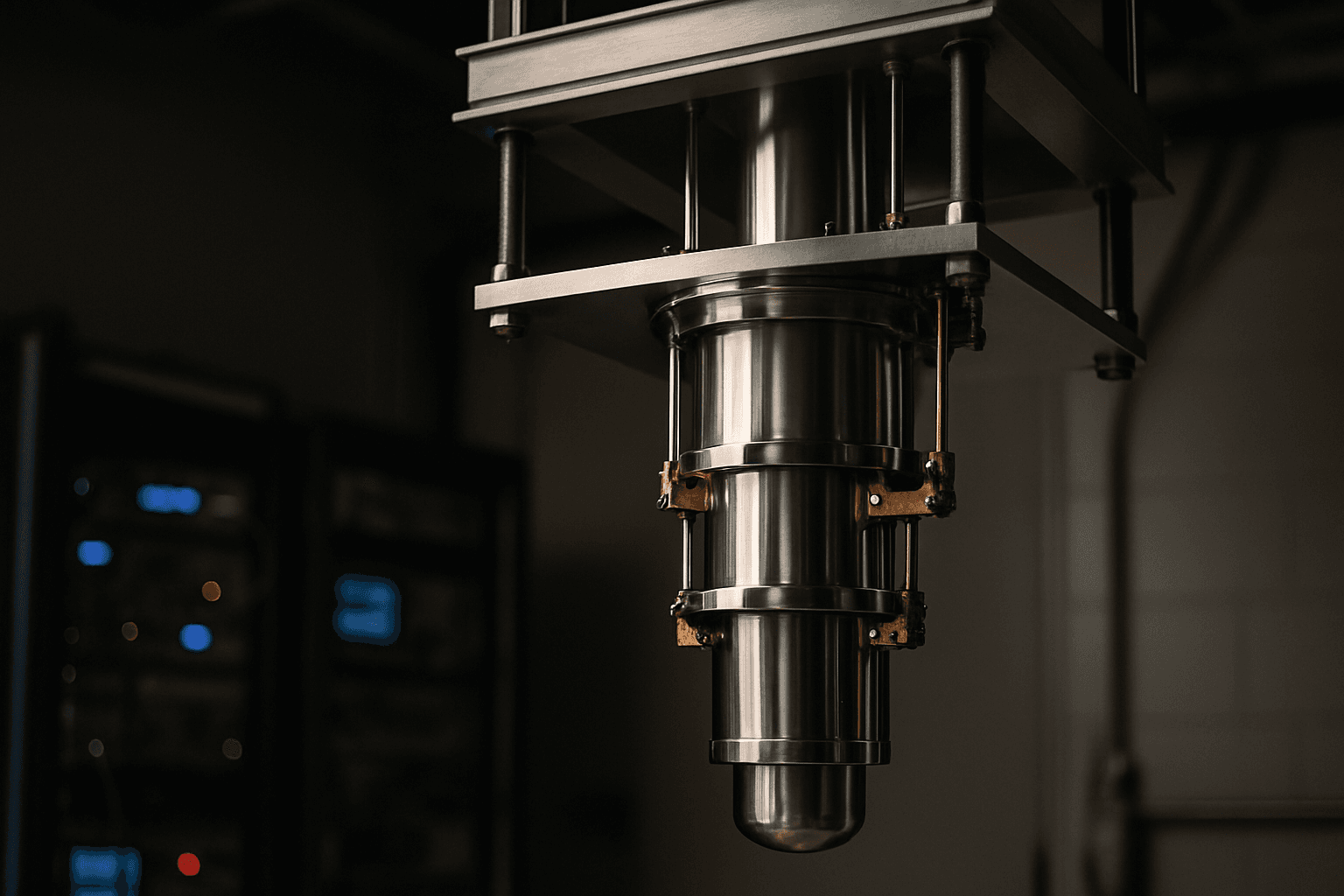
Microsoft unveiled Majorana 1 on February 19, calling its eight-qubit chip the world's first topological quantum processor and the product of a nearly 20-year pursuit.
The chip's companion Nature paper, titled "Interferometric single-shot parity measurement in InAs-Al hybrid devices," reported a technique for reading qubit state quickly and accurately. Microsoft's announcement described that paper as "peer-reviewed confirmation" the company had "created Majorana particles" and could "reliably measure that information." Nature's editorial team attached a note: "the results in this manuscript do not represent evidence for the presence of Majorana zero modes in the reported devices."
CEO Satya Nadella called it the product of "a nearly 20-year pursuit" into "an entirely new state of matter." Majorana 1's substrate is designed to scale to one million qubits, Microsoft says.
The Critics
John Preskill, the Caltech physicist who coined "quantum supremacy" in 2012, said there was "no publicly available evidence that this test has been conducted successfully." Jonathan Oppenheim at UCL put it plainly: "They haven't shown that they have a topological qubit."
Sergey Frolov at the University of Pittsburgh called the work "essentially fraudulent." His 2021 investigation triggered Microsoft's retraction of a 2018 Nature paper on the same physics, after he showed ordinary Andreev states could mimic the signal. Henry Legg at St Andrews posted a preprint on March 11 calling the work "not reliable."
The topological gap protocol Microsoft uses to confirm Majorana signatures, Legg wrote, "doesn't give any information about the actual physics." Results shift depending on which measurement ranges are applied.
The Hardware
At the March APS meeting, Chetan Nayak acknowledged the key X-measurement signal "was difficult to see due to electrical noise." A June 2025 arXiv preprint measured X-type parity lifetimes at 14.5 microseconds with a 16% error rate, and Z-type measurements at 12.4 milliseconds with 0.5% error.
Shorter measurement windows are better: faster readout gives decoherence less time to corrupt the result, and Microsoft's roadmap targets 1 microsecond, down from the current 32.5 microseconds. A University of Sydney and UNSW study puts the 1/f semiconductor noise floor at a few nanoseconds. That is roughly 10,000 times shorter than today's hardware requires, and 1,000 times shorter than the roadmap target.
What a Buyer Gets
Azure Quantum's provider list as of May 2026 offers four hardware platforms: IonQ (up to 36 qubits), Pasqal (100 qubits), Quantinuum (32 qubits), and Rigetti (108 qubits). Majorana 1 is absent. There is no subscription tier, no Q# integration path, and no developer preview for topological hardware.
Nadella has projected commercial quantum systems in data centers by 2029. Microsoft's published roadmap names six milestones. Majorana 1 sits at stage two, with four remaining before the roadmap reaches a quantum supercomputer.
The four milestones remaining on the roadmap force the February announcement into a single reading: capital markets, not the physicist demanding evidence or the enterprise buyer.
The X-type error rate stands at 16%, against a fault-tolerance threshold below 1%. Microsoft's current measurement window runs 32.5 microseconds; the roadmap wants 1 microsecond. The 2029 commercial date remains the only public marker, and no customer has contracted against it.