Tech
Menlo Open-Sourced Its Humanoid. Unitree Didn't.
Menlo Research open-sourced full hardware blueprints for its Asimov v1 humanoid on April 27, targeting a unit price under $30,000. Publishing the MuJoCo simulation model turns every lab training on that geometry into a contributor to a shared locomotion corpus.
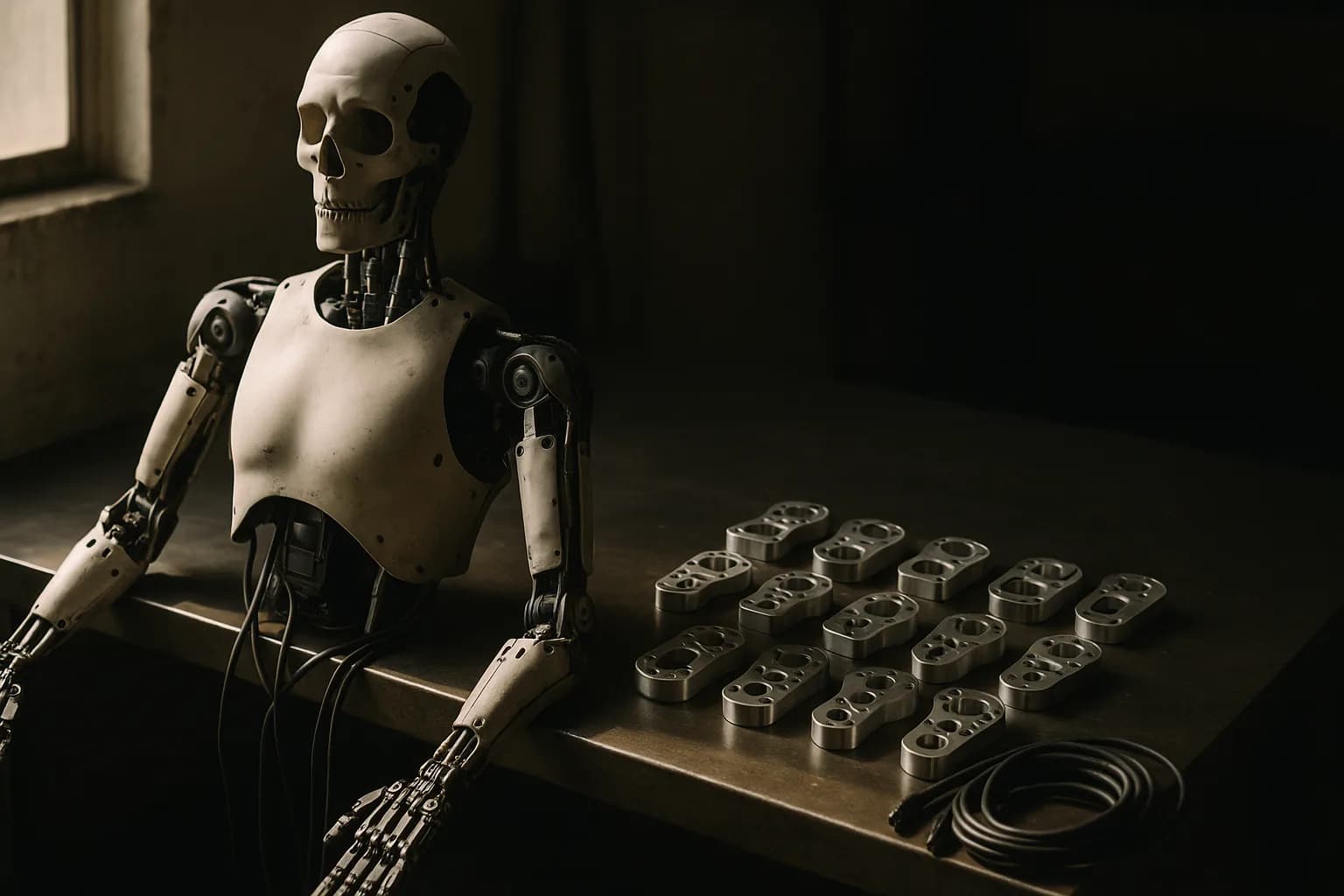
Menlo Research open-sourced its Asimov v1 humanoid on April 27, releasing mechanical CAD, wiring harness files, and a MuJoCo simulation model at github.com/asimovinc/asimov-1. The robot stands 1.2 meters, weighs 35 kilograms, and runs 25 actuated degrees of freedom with 120 Newton-meters of peak torque.
CNC-machined 7075 aluminum carries the load-bearing frame; MJF-printed PA12 nylon fills the rest, keeping most structural parts reproducible with commercial powder-bed printing. A "Here Be Dragons" DIY kit carries a $499 deposit and a $15,000 target price, with summer 2026 delivery. Menlo's handbook states the design constraint as a sub-$30,000 fully assembled unit, achievable through supply chain competition rather than vertical integration.
The nearest alternative, Unitree's G1, lists at $16,000 with no public CAD; its base model peaks at 90 Nm of knee torque, below Asimov's 120 Nm ceiling. The G1 EDU tier matches at 120 Nm and 43 degrees of freedom; its locomotion record covers front flips and 2 meters per second in public demos. Asimov v1 has no locomotion data yet.
Menlo traced Asimov's origin to a two-month wait for a single G1 knee joint that halted its research program. The company is bootstrapped, Singaporean, and does not publicize its founders. Its earlier product, Jan, is an open-source LLM runner with 5.3 million downloads and 41,000 GitHub stars; Asimov ships under CERN-OHL-S-2.0 for hardware and GPL-2.0 for software.
The open-source release includes a MuJoCo model built with Processor-in-the-Loop methodology, injecting CAN bus latencies up to 9 milliseconds and sensor noise into training runs. The goal is zero-shot sim-to-real transfer: policies trained in simulation run on hardware without manual retuning. Schaeffler committed to 1,000 to 2,000 robots from a single funded startup running proprietary simulation geometry; Menlo is wagering that a public blueprint compounds faster.
Publishing open simulation geometry at this price changes the math on training data accumulation. Labs building on the same MuJoCo model produce locomotion policies on identical virtual hardware; those trajectories accumulate publicly rather than in one company's private corpus. Each contributing lab strengthens the policy base for every other lab on the same design, a dynamic that proprietary geometry forecloses.
California's 2026 minimum wage of $16.90 an hour runs to $35,152 a year; Asimov's sub-$30,000 hardware already falls under that one-year figure. Kit delivery targets summer 2026, assembly to first power-on takes 50 to 100 hours, and walking comes after that. Locomotion data from hardware in builders' hands is unlikely before late 2026, which is the earliest the zero-shot transfer claim is testable.